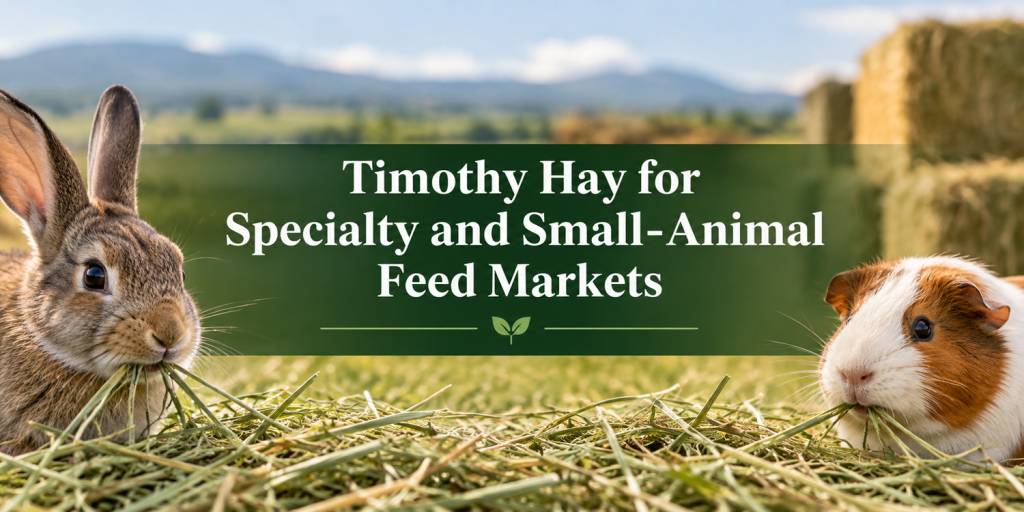
Timothy hay is the preferred everyday forage for rabbits, guinea pigs and other small herbivorous pets, which makes it a genuine commercial category in its own right — distinct from the equine and livestock markets this site covers elsewhere. This guide is written for the commercial side of that market: feed and treat manufacturers, pet-product companies packaging hay for retail, wholesale distributors, and institutional buyers such as zoos and exotic-animal facilities sourcing Timothy in bulk. It isn’t written for an individual choosing a bag of hay at a pet store — that’s a question for a retailer or veterinarian, not an export supplier.
Why Timothy hay is the preferred base forage for small herbivores
Rabbits and guinea pigs are both hindgut fermenters — their digestive systems rely on an enlarged cecum, not a ruminant stomach, to ferment fibrous plant material. According to the Merck Veterinary Manual’s guidance on rabbit nutrition, rabbits need roughly 15% crude fiber to support intestinal motility, and hay fed ad lib — Timothy runs roughly 30–35% fiber — comfortably meets that requirement. The large, fibrous particles in hay act as a mechanical “scratch factor” that keeps digesta moving through the gut; without adequate fiber, the same source notes increased risk of intestinal problems including enterotoxemia linked to pathogens like Clostridium spiroforme.
NC State University’s College of Veterinary Medicine describes essentially the same pattern for guinea pigs: hay should make up roughly 80% of the diet and be available at all times, with Timothy (alongside orchard grass) named as the standard base grass hay. Both sources converge on the same reason Timothy specifically, rather than a legume hay, is the default maintenance forage: Timothy’s lower calcium and protein content suits adult maintenance better than Alfalfa, which both sources reserve for specific life stages — young, growing or lactating animals with genuinely higher calcium and protein needs. Merck notes a target of around 0.4–0.5% dietary calcium for non-lactating rabbits, a level a Timothy-based diet supports more easily than an Alfalfa-based one. See the full Timothy vs. Alfalfa comparison →
The commercial implication: demand for Timothy in this category isn’t a fad or a niche preference — it follows directly from how these animals’ digestive systems work, which is why it shows up as a base ingredient across feed formulations, treats, bedding-adjacent hay products and private-label retail hay nationwide.
Who buys Timothy hay for specialty and small-animal markets
This is a more varied buyer base than the equine or livestock segments:
- Specialty and small-animal feed or treat manufacturers, formulating hay-based pellets, treats or mixed-forage products
- Pet-product companies packaging and private-labeling loose hay for retail sale
- Wholesale distributors supplying specialty pet retail chains and independent pet stores
- Zoos, wildlife sanctuaries and exotic-animal care facilities, feeding rabbits, guinea pigs and other small herbivores as part of institutional animal care programmes
- Veterinary and laboratory-animal facilities maintaining rabbits or guinea pigs under a controlled nutrition programme
Volumes per order are often smaller than a bulk livestock or dairy contract, but the buyers in this category tend to need tighter consistency and presentation standards, because their own end product is judged directly by a retail customer or an institutional nutrition protocol.
What this market needs differently from equine or livestock buyers
A specialty feed buyer is evaluating Timothy hay as an input to their own product, not as a finished ration component, which changes what matters most:
- Appearance and leaf retention matter more, not less, than in bulk livestock buying. Retail hay is often sold loose or in clear packaging where the end customer can see exactly what they’re buying. What grade names and leaf retention actually describe →
- Dust and cleanliness are a bigger presentation issue. Beyond any animal-health consideration, visibly dusty or inconsistent hay reads poorly in retail packaging in a way it may not in a bulk feed context. How to physically inspect Timothy hay before you buy →
- Cutting and texture preference often lean toward second cut. Finer-stemmed, softer hay suits small-animal palatability and handling better than coarser first-cut material in many retail and formulation contexts — though this depends on the specific product and shouldn’t be assumed universally. First cut vs. second cut Timothy compared →
- Bale format needs to match a repackaging or manufacturing line, not a feeding operation — ask what format and weight suits your own processing or bagging equipment rather than defaulting to the configuration built for bulk livestock shipment.
- Lot-to-lot consistency matters for formulation stability. A feed manufacturer reformulating a recipe every time a hay lot shifts has a real cost problem; ask how an exporter assembles volume across fields and cuttings.
- Import classification can differ from bulk livestock feed. Depending on destination and on how the product will be sold (loose forage, a formulated feed ingredient, or a packaged consumer product), the applicable import category and documentation may not be identical to a standard livestock hay shipment. This varies by country and by product classification — confirm with your destination’s import authority and your own regulatory team rather than assuming livestock-feed documentation automatically covers a specialty retail product. Full export documentation guide →
Specification questions to bring to an exporter
- What’s the certificate of analysis for this lot, including crude fiber?
- Is this first cut or second cut, and which suits our product line?
- What’s the moisture figure, and how was it confirmed?
- Can we see current crop photographs or get a sample before committing to volume?
- What bale formats are available, and can they be adapted to our repackaging process?
- How is volume assembled across fields and cuttings — will our next order match this one?
- What documentation applies to our specific product classification and destination?
See our packaging and shipping options →
Timothy vs. Alfalfa for small-animal feed formulations
The same distinction that applies across this site’s other content holds here: Timothy is not nutritionally superior to Alfalfa, and Alfalfa is not inferior — they suit different formulations and life stages. Both the Merck Veterinary Manual and NC State’s veterinary guidance reserve Alfalfa for growing, young or lactating animals specifically because of its higher calcium and protein content, while treating Timothy as the appropriate base for adult maintenance feeding. A specialty feed manufacturer serving multiple life-stage products may reasonably need both. Full Timothy vs. Alfalfa comparison →
Frequently asked
Is Timothy hay nutritionally necessary for rabbits and guinea pigs, or is any grass hay acceptable? Veterinary sources name Timothy (often alongside orchard grass) as the standard base grass hay for adult maintenance feeding, mainly for its fibre profile and comparatively low calcium and protein relative to legume hay. This is general veterinary guidance, not Western Forage product advice — individual formulation decisions should involve a nutritionist or veterinarian.
What’s the difference between Timothy and Alfalfa for small-animal feed formulations? Alfalfa carries more calcium and protein, which veterinary sources associate with growth, pregnancy and lactation needs specifically. Timothy’s lower calcium and protein profile suits general adult maintenance better. Neither is universally better — the right choice depends on the life stage and product the formulation targets.
What bale format suits a specialty feed manufacturer repackaging hay for retail? It depends on your processing and bagging line — tell us your equipment and target package size, and we can advise on formats that are practical to adapt, rather than assuming the configuration built for bulk livestock shipment will suit a retail repackaging operation.
Does small-animal feed hay need different export documentation than livestock feed? Potentially, depending on your destination and how the product will be classified and sold. Confirm the applicable requirement with your destination’s import authority and your own regulatory or compliance team before shipping — don’t assume standard livestock documentation automatically covers a specialty retail or formulated product.
Can Western Forage supply custom or private-label packaging for retail hay products? Tell us your target package format, volume and destination, and our export team will advise on what we can support.
Request Timothy hay for your specialty feed programme
Tell us your product type, target specification, cutting preference and volume, and our export team will come back with current availability, certificate of analysis, and packaging options suited to your operation.