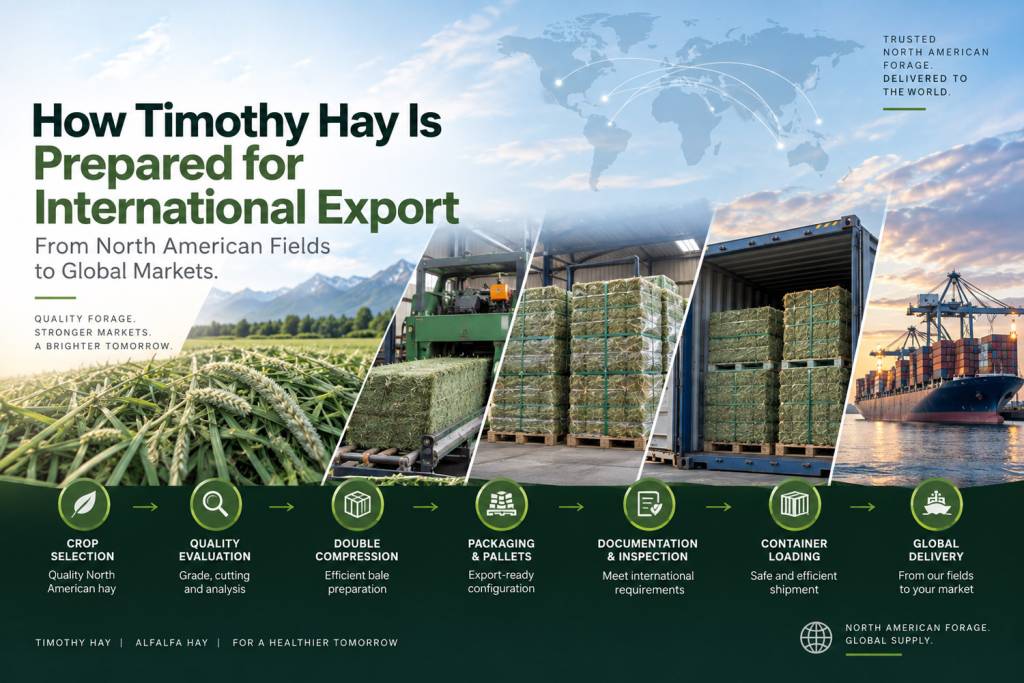
Exporting Timothy Hay involves much more than purchasing bales and loading them into a shipping container.
International forage buyers expect the correct crop, grade, cutting, bale format, documentation and shipment configuration to arrive at destination.
A successful shipment therefore begins well before the container reaches the loading facility.
At Western Forage, the process connects North American production and grower relationships with quality selection, in-house compression and international export operations.
Here is how that process works.
Step 1: Understand the Buyer’s Requirement
The first step should not be selecting hay.
It should be understanding the customer.
Commercial buyers may have requirements regarding:
- Intended use
- Grade
- Cutting
- Color
- Stem characteristics
- Moisture
- Crude protein
- RFV
- ADF/NDF
- Bale format
- Origin
- Container quantity
- Destination
- Documentation
A premium equestrian importer and a dairy feed company may need very different Timothy products.
Understanding the application helps determine which available crop should be offered.
Step 2: Review Current Crop Availability
Timothy changes from season to season.
Weather, rainfall, heat, harvest timing and maturity influence the finished crop.
Available lots should therefore be evaluated against the buyer’s actual requirements.
Western Forage works with North American production and established grower relationships to identify suitable forage for commercial programs.
Step 3: Select the Grade & Cutting
The next step is matching the crop to the customer’s quality requirement.
Timothy may be positioned into different commercial grades based on characteristics such as:
- Color
- Stem
- Leaf content
- Maturity
- Cleanliness
- Consistency
The customer may also prefer first or second cut.
Rather than automatically recommending the highest grade, the objective should be to identify the most appropriate grade for the intended market.
Step 4: Review Available Analysis
Where nutritional specifications are important, available crop analysis can be reviewed.
This may include:
- Moisture
- Crude protein
- ADF
- NDF
- RFV
Laboratory information should be considered alongside the physical characteristics of the crop.
Step 5: Confirm the Commercial Terms
Before preparing the shipment, buyer and seller should establish:
- Quantity
- Price
- Incoterm
- Destination port
- Payment terms
- Product specifications
- Required documentation
- Shipment window
International quotations may be structured on FOB, CFR or CIF terms depending on the transaction.
Step 6: Prepare the Hay for Compression
Once the appropriate crop has been selected, the hay can move into export preparation.
Western Forage operates an in-house hay compression facility, giving our team greater involvement in this important stage.
The processing team monitors the hay entering the pressing operation and can identify visible unsuitable or foreign material during preparation.
Step 7: Double Compress the Hay
Double compression reduces the physical volume of the forage and allows it to be transported more efficiently in international containers.
Depending on customer requirements, Timothy can be prepared in formats such as:
- Full-cut double-compressed bales
- Half-cut double-compressed bales
- Other suitable commercial bale configurations
Bale format should be confirmed before loading.
Step 8: Prepare Packaging & Pallets
Compressed bales are prepared according to the shipment configuration.
Depending on the program, this can include wrapping, palletization and identification required for loading and distribution.
The loading plan considers:
- Bale dimensions
- Bale weight
- Pallet dimensions
- Container dimensions
- Weight distribution
- Customer unloading requirements
Step 9: Coordinate Inspection & Documentation
Agricultural exports can be subject to destination-specific plant-health and import requirements.
Depending on origin and destination, the shipment may require phytosanitary inspection and certification.
Other commercial documents can include:
- Commercial Invoice
- Packing List
- Certificate of Origin
- Phytosanitary Certificate
- Bill of Lading or Sea Waybill
- Weight documentation
- Product analysis
- Other destination-specific documents
Requirements should be confirmed before shipment.
Step 10: Inspect the Container
Before loading, the container should be reviewed for suitability.
The loading team should consider general container condition and whether the unit is appropriate for the commodity.
Forage should be protected from unnecessary exposure to moisture during loading.
Step 11: Load the Container
The compressed hay is then loaded according to the planned configuration.
Loading should consider:
- Pallet placement
- Bale stability
- Weight distribution
- Door clearance
- Container capacity
- Transportation limits
Western Forage also uses shipment photographs to document important stages of the loading process.
Step 12: Seal & Document the Shipment
Once loading is complete, the container is closed and sealed.
Relevant shipment information can be recorded, including container and seal details.
Final commercial documents are then prepared according to the transaction.
Step 13: Move the Container to Port
The loaded container is transported to the applicable North American export gateway.
Depending on crop origin and routing, shipments may move through Pacific ports serving international forage markets.
Cut-off dates, terminal requirements and vessel schedules must be coordinated carefully to reduce unnecessary delays.
Step 14: Ocean Shipment & Destination
After export clearance and vessel loading, the container begins its ocean journey.
Transit times and routing depend on:
- Destination
- Shipping line
- Vessel schedule
- Transshipment
- Port conditions
The importer then completes the applicable destination procedures before taking delivery.
Why Vertical Involvement Matters
Every additional handoff creates another point where communication can be lost.
Western Forage’s model connects:
Production & Grower Network → Crop Selection → In-House Compression → Export Preparation → Container Loading → International Shipment
This gives our customers a clearer view of how their Timothy Hay moves from North American fields into an export container.
What Buyers Should Provide Before Requesting a Quote
For a meaningful quotation, provide:
- Company
- Destination country
- Destination port
- Intended use
- Grade
- Cutting
- Nutritional requirements
- Bale format
- Initial container quantity
- Monthly requirement
- FOB, CFR or CIF preference
- Required documentation
The more clearly the requirement is defined, the more accurately a suitable crop can be identified.
From North American Fields to Global Markets
Western Forage supplies Timothy Hay to commercial customers across international markets.
Our objective is to provide more than a product quotation. We connect forage selection, processing, export preparation, and logistics into one commercial supply process.
North American Forage. In-House Compression. Global Supply.
[Explore Timothy Hay]
[View Packaging & Shipping]
[View Export Information]
[Request Current Availability]