Timothy Hay and Alfalfa Hay are two of the most widely recognized forage products in equestrian, dairy and livestock markets. But they are fundamentally different crops.
Timothy is a grass. Alfalfa is a legume.
That difference affects their protein, fiber, calcium, physical characteristics and common feeding applications.
For commercial buyers, the question is not simply whether Timothy Hay or Alfalfa Hay is “better.” The right choice depends on the animal, nutritional requirements, customer preferences, available crop and price.
Western Forage supplies North American Timothy Hay and Alfalfa Hay to importers, distributors, equestrian businesses, dairy operations and commercial livestock customers.
This guide explains the major differences and what buyers should consider before choosing between them.
Timothy Hay vs. Alfalfa Hay: Quick Comparison
| Characteristic | Timothy Hay | Alfalfa Hay |
| Plant type | Grass | Legume |
| Protein | Generally lower | Generally higher |
| Calcium | Generally lower | Generally higher |
| Physical characteristics | Long grass stems and leaves; seed heads depending on maturity | Leaf-rich stems |
| Common applications | Equestrian, livestock, forage distribution | Dairy, livestock, equestrian |
| Key quality factors | Cutting, maturity, stem, leaf, color, cleanliness | Protein, fiber, leaf retention, maturity, color |
| Commercial selection | Grade + physical characteristics + analysis | Analysis + maturity + physical characteristics |
| Export format | Available double compressed | Available double compressed |
These are general differences. Actual nutritional values vary according to growing region, cutting, maturity, weather and individual crop.
Where nutritional specifications are important, buyers should review analysis from the actual lot being offered.
What Is Timothy Hay?
Timothy (Phleum pratense) is a cool-season perennial grass widely used as forage for horses and livestock.
North American Timothy is commercially grown across important production regions in the United States and Canada and is particularly well established in international equestrian forage markets.
Commercial Timothy buyers commonly evaluate:
Cutting • Maturity • Stem • Leaf • Color • Moisture • Cleanliness • Fiber Characteristics • Consistency
Depending on the intended application, buyers may also review crude protein, ADF, NDF and other available laboratory measurements.
Timothy quality can vary considerably between fields and crop years. This is why buyers should evaluate the actual product rather than relying solely on labels such as “Premium.”
What Is Alfalfa Hay?
Alfalfa (Medicago sativa) is a perennial legume widely used in dairy, livestock and equestrian feeding programs.
Compared with typical grass hay, Alfalfa is generally associated with higher concentrations of crude protein and calcium.
Commercial buyers often evaluate Alfalfa according to:
Crude Protein • ADF • NDF • RFV/RFQ • Leaf Retention • Maturity • Moisture • Color • Cleanliness
Leaf retention is particularly important because the leaves represent a significant nutritional component of the plant.
As with Timothy, actual quality varies according to maturity, cutting, growing conditions, harvest timing and storage.
Alfalfa Hay for Dairy & Livestock →
Protein and Nutritional Differences
One of the most commonly discussed differences between Timothy and Alfalfa is protein.
Alfalfa generally contains more crude protein than Timothy Hay.
However, higher protein does not automatically make a forage better.
A dairy operation, growing animal and recreational horse may have very different nutritional requirements. The forage needs to be considered within the complete feeding program.
For commercial buyers, the stronger approach is to determine the required nutritional specification first and then identify a forage that fits that requirement.
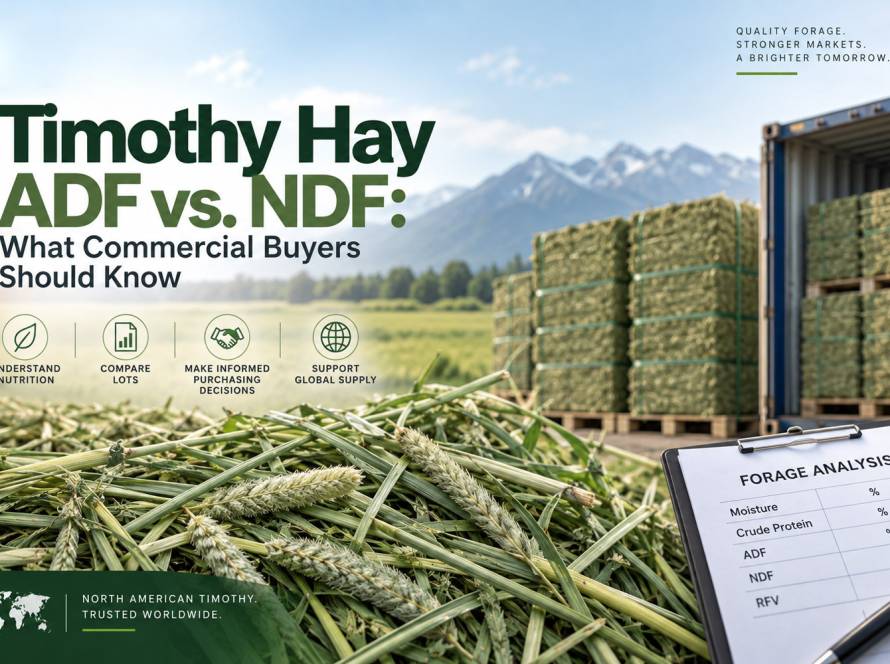
ADF and NDF in Timothy and Alfalfa Hay
Commercial forage analysis commonly includes ADF and NDF.
ADF – Acid Detergent Fiber
ADF represents a fiber fraction commonly used when evaluating forage digestibility characteristics.
NDF – Neutral Detergent Fiber
NDF represents a broader structural fiber fraction and is commonly considered when evaluating forage characteristics and potential intake.
These measurements are useful, but neither should be used alone to determine forage quality.
Buyers should consider:
ADF + NDF + Protein + Moisture + Maturity + Physical Characteristics + Intended Use
The University of Minnesota Extension provides additional information on forage quality measurements, including ADF, NDF, RFV and RFQ.
EXTERNAL LINK: Measuring Forage Quality – University of Minnesota Extension
Timothy Hay vs. Alfalfa Hay for Horses
Both Timothy and Alfalfa are used in equestrian feeding programs.
Timothy is a grass forage and is commonly selected by equestrian buyers looking for characteristics such as:
- Appropriate stem structure
- Leaf content
- Cleanliness
- Color
- Maturity
- Cutting
- Moisture
- Consistency
Alfalfa has a different nutritional profile and generally provides higher protein and calcium than typical grass hay.
Some equestrian feeding programs rely primarily on grass hay, while others incorporate Alfalfa according to the horse’s nutritional requirements.
Neither forage is universally better for every horse.
For commercial equestrian buyers, the important question is whether the forage matches the customer, feeding program and quality expectations of the market.
Timothy Hay for Horses: An Equestrian Buyer’s Guide →
Timothy Hay vs. Alfalfa Hay for Dairy & Livestock
Commercial dairy and livestock buyers often evaluate forage differently from premium equestrian buyers.
Appearance still matters, but nutritional characteristics can carry greater importance.
Alfalfa is widely used within dairy feeding programs because of its nutritional characteristics, while Timothy and other grass forages can also be used depending on ration objectives.
Commercial buyers may evaluate:
- Crude protein
- ADF
- NDF
- RFV or RFQ where applicable
- Moisture
- Maturity
- Leaf retention
- Consistency
- Cost per metric ton
The appropriate forage ultimately depends on how it fits within the complete feeding program.
INTERNAL LINK: Alfalfa Hay for Dairy & Livestock → /alfalfa-hay-for-dairy-livestock/
What Should Commercial Buyers Compare?
When comparing Timothy and Alfalfa quotations, importers should look beyond the product name and price.
Grade and Quality
Grade terminology is not always standardized between suppliers.
A product marketed as “Premium” by one supplier may not be identical to another supplier’s Premium grade.
Ask what characteristics define the product being offered.
INTERNAL LINK: Timothy Hay Grades Explained → /timothy-hay-grades/
Cutting and Maturity
Cutting and maturity can influence stem, leaf, fiber and overall crop characteristics.
For Timothy buyers, understanding the difference between first and second cutting can be particularly useful.
First Cut vs. Second Cut Timothy Hay →
Current Crop Condition
Request photographs or videos of the current crop whenever possible.
Marketing photographs from a previous season may not accurately represent the hay currently available.
How to Identify Premium Timothy Hay →
Laboratory Analysis
Where nutritional characteristics are important, request available analysis for the actual lot.
This may include moisture, crude protein, ADF, NDF, RFV or RFQ depending on the product and market.
Bale Format and Packaging
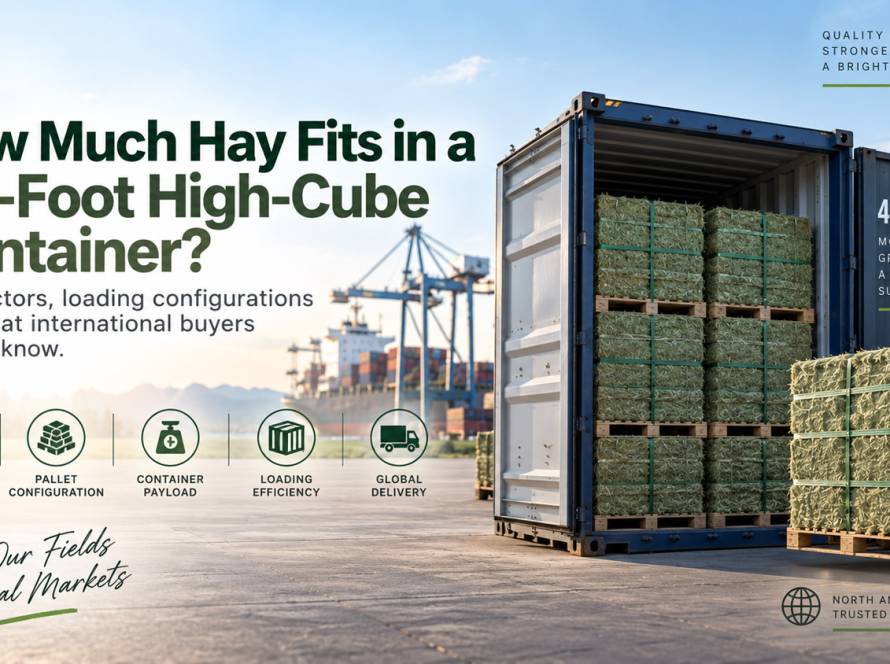
International buyers should also confirm whether the hay is full-cut, half-cut or another format, along with approximate bale weight and packaging configuration.
Western Forage prepares forage for international markets through our in-house hay compression operation.
Price vs. Landed Cost
There is no permanent answer to whether Timothy or Alfalfa is more expensive.
Pricing changes according to:
Crop Year • Grade • Cutting • Growing Region • Weather • Supply • Demand • Packaging • Transportation • Ocean Freight
For international buyers, FOB product price is only part of the calculation.
A more meaningful comparison is:
Product Cost + Inland Logistics + Ocean Freight + Destination Costs = Landed Cost
A cheaper hay quotation is not necessarily the better commercial purchase if the specification, loading efficiency or freight economics are substantially different.
Which Hay Is Better for International Importers?
The answer depends primarily on the market being served.
An importer supplying premium equestrian customers may have strong demand for visually attractive Timothy with specific stem, leaf and cutting characteristics.
A distributor supplying dairy or livestock operations may place greater emphasis on nutritional analysis, consistency and feed economics.
A diversified forage distributor may benefit from carrying both.
For many commercial buyers, the decision is therefore not necessarily Timothy or Alfalfa.
It may be Timothy and Alfalfa, with each forage positioned for the customers it serves best.
FAQ’s
Is Timothy Hay better than Alfalfa Hay?
Neither is universally better. Timothy is a grass and Alfalfa is a legume. The appropriate forage depends on the animal, feeding program, nutritional requirements and customer preferences.
Which has more protein, Timothy or Alfalfa?
Alfalfa generally contains more crude protein than Timothy. Actual protein levels vary by crop, maturity, cutting and growing conditions, so commercial buyers should review available analysis where protein specifications are important.
Is Timothy or Alfalfa better for horses?
Both are used in equestrian feeding programs. Timothy is a grass forage, while Alfalfa generally provides higher protein and calcium. The appropriate choice depends on the horse and complete feeding program.
Which hay is commonly used for dairy cattle?
Alfalfa is widely used in dairy feeding programs because of its nutritional characteristics. Timothy and other grass forages may also be incorporated depending on the complete ration.
Can Timothy and Alfalfa be double compressed for export?
Yes. Both products can be prepared in compressed formats for international shipment. Bale configuration and loading specifications should be confirmed for the particular crop and shipment.