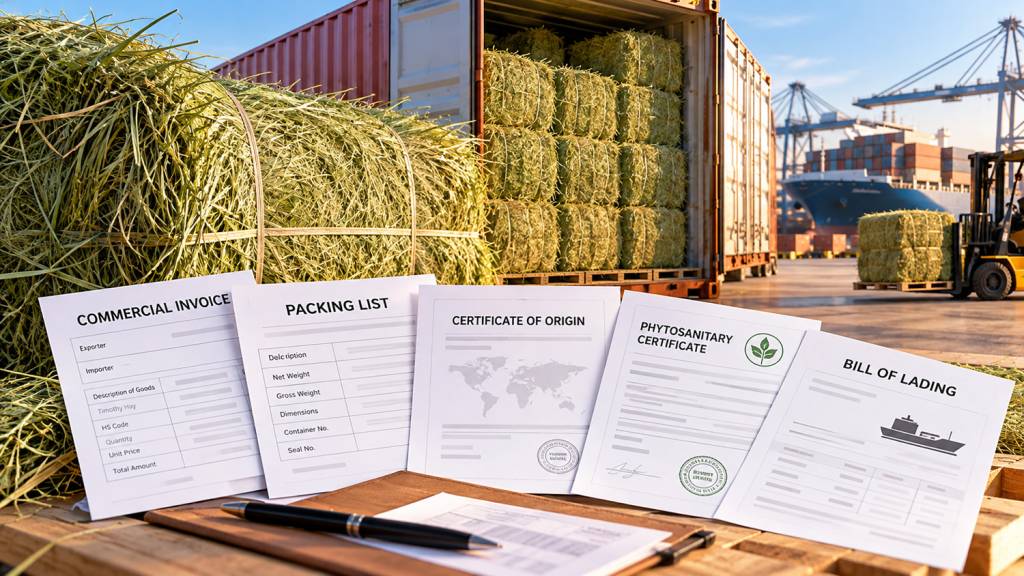
A Timothy hay shipment typically arrives with a specific set of paperwork — a commercial invoice, packing list, certificate of origin, phytosanitary certificate, and a bill of lading or sea waybill, at minimum. Most buyer-facing content stops at naming that list. This guide goes one step further: what each document actually is, who issues it, when you receive it, and how it’s used to clear your shipment at destination.
If you want the end-to-end view of how a shipment is prepared before it reaches this stage, see how Timothy hay is prepared for export →. This article picks up where that one’s documentation step leaves off.
The core document set, at a glance
| Document | Who typically issues it | What it’s for |
|---|---|---|
| Commercial Invoice | The exporter | Legal bill for the goods; basis for customs duty assessment |
| Packing List | Compiled by the exporter, often on a freight-forwarder’s form | Detailed inventory customs uses to check cargo against the invoice |
| Certificate of Origin | A chamber of commerce (not a government body, in most cases) | Declares where the goods originated; used for duty assessment and trade-agreement eligibility |
| Phytosanitary Certificate | A government plant-health authority (USDA APHIS in the US; CFIA in Canada) | Confirms the plant product meets the destination’s pest/disease requirements |
| Bill of Lading or Sea Waybill | The ocean carrier, issued to the shipper | Contract of carriage; a negotiable bill of lading is also a document of title needed to claim the cargo |
Each is covered in detail below.
Commercial Invoice
The commercial invoice is prepared by the exporter and functions, in the words of the US International Trade Administration’s export documentation guide, as “a bill for the goods from the seller to the buyer.” It describes the goods and states what the buyer owes. Destination customs authorities use it as the primary basis for assessing duties, and some importing governments set specific requirements for its format, number of copies, or language — which is one of the destination-specific details worth confirming before shipment rather than assuming a standard template covers every market.
Packing List
The packing list is a detailed inventory: parties involved, invoice number, shipment date, transport mode and carrier, and — critically for customs inspection — itemized quantities, package counts and types, net and gross weights, and dimensions. Trade.gov notes that customs officials use it to physically check cargo against what’s declared, and that it isn’t a substitute for the commercial invoice — the two should be consistent with each other. For a Timothy hay shipment, this is where bale counts, weights and container loading details are formally recorded.
Certificate of Origin
A certificate of origin is a signed statement of where the goods originated. Despite how official it looks, in most cases it isn’t issued by a government body at all — the American World Trade Chamber of Commerce notes that non-preferential certificates of origin are typically issued by chambers of commerce as a trade-facilitation service, acting as a neutral third-party check that gives customs authorities and banks more confidence than an exporter’s own declaration. Destination customs use it to assess duties and apply trade rules; banks may require it to satisfy letter-of-credit terms. Shipments moving under a free trade agreement (such as USMCA for US–Canada–Mexico trade) typically need a separate, specific certification to claim preferential duty treatment — a standard non-preferential certificate of origin doesn’t automatically qualify a shipment for those benefits.
Phytosanitary Certificate
Because hay is a plant product, most destination countries require a phytosanitary certificate confirming it has been inspected and meets their pest and disease requirements. In the United States, USDA APHIS issues these through its certification specialists and Authorized Certification Officials (ACOs), who arrange the required inspection and process the application through APHIS’s Phytosanitary Certificate Issuance and Tracking System (PCIT). Canadian exports go through the equivalent process with the Canadian Food Inspection Agency (CFIA). The certificate follows the inspection — an exporter applies after confirming the destination country’s specific requirements, since these vary by commodity and by country and are tracked through official databases rather than assumed. Japan’s own 2023 change to its phytosanitary requirements is a real example of how these rules shift — a requirement that applied one year may not describe the rule the next.
Bill of Lading or Sea Waybill
This is the document most likely to cause confusion at destination if an importer doesn’t know which type is being used, because the two work differently.
A bill of lading is issued by the ocean carrier to the shipper and serves as the contract of carriage. According to Maersk’s own explanation of the distinction, a negotiable bill of lading is also a document of title — ownership can pass to a third party by endorsement, and the original document must be physically presented at the port of discharge before the carrier releases the cargo. A non-negotiable (straight) bill names the consignee directly and doesn’t transfer by endorsement, but Maersk notes at least one original generally still needs to be submitted, unless replaced by an electronic telex release.
A sea waybill is simpler for the importer: it’s non-negotiable, it isn’t a document of title, and no original needs to be presented — the carrier releases the cargo to the named consignee once identified. Sea waybills suit transactions where buyer and seller already have an established, trusting relationship and don’t need the extra security a negotiable bill provides; a negotiable bill of lading is more common where payment is tied to a letter of credit or the cargo may change ownership in transit.
The practical takeaway: ask your exporter which type your shipment will use, and if it’s a negotiable bill of lading, make sure you know who holds the original and how it will reach you in time to clear the cargo — a missing original can hold a shipment at port even after it has physically arrived.
Other documents that may accompany a shipment
- Certificate of Analysis — issued by a laboratory, not a customs authority. It confirms moisture, protein, fibre (ADF/NDF) and other quality figures for the specific lot. It isn’t typically a customs requirement, but it’s one of the most commercially important documents in the package, since it’s what you check the shipment against. How to read a hay analysis →
- Weight documentation — may come from an independent inspection service or the loading facility, confirming cargo weight for customs valuation and, in some transactions, for payment verification.
- Insurance certificate — relevant specifically under CIF terms, where the exporter arranges marine cargo insurance; the certificate is what you’d use to make a claim if cargo is lost or damaged in transit. FOB, CFR and CIF explained →
- Fumigation or wood-packaging treatment documentation — if the shipment uses wood pallets, many destinations require ISPM-15 treatment marking; confirm whether this applies to your specific packaging and route.
How documentation requirements change by destination
None of the documents above come with a single, universal rulebook. Phytosanitary requirements, certificate-of-origin acceptance, and even which bill-of-lading type is practical for a given trade lane all vary by destination country and change over time — Japan’s 2023 phytosanitary rule change is one concrete, recent example. Treat “what documents does my shipment need” as a question to confirm for your specific country and product classification before every shipment, not a fixed list to assume from a previous order.
What to check when your documents arrive
- Does the packing list match the commercial invoice — same quantities, weights and package counts?
- Does the certificate of origin state the origin you expected, and does your shipment qualify for any trade-agreement preference you’re relying on?
- Is your bill of lading negotiable or straight, and do you know who holds the original and how it will reach you?
- Is the phytosanitary certificate valid for your specific product and destination, and does it cover the correct commodity description?
- Does the certificate of analysis match what you ordered — grade, cutting, moisture?
Request current documentation details for your shipment →
Frequently asked
What’s the difference between a bill of lading and a sea waybill, and which will my shipment use? A bill of lading can be a negotiable document of title requiring a physical original to release cargo; a sea waybill is non-negotiable and releases directly to the named consignee with no original needed. Which one applies depends on the transaction and payment terms — ask your exporter directly rather than assuming.
Who issues the phytosanitary certificate for a Timothy hay shipment? In the US, an APHIS-authorized certification official issues it after inspection, through APHIS’s official tracking system. Canadian exports go through the CFIA’s equivalent process. Requirements vary by destination country, so the specific process depends on where the shipment is going.
Does every Timothy hay shipment need a certificate of origin? Most shipments carry one, but requirements vary by destination, and a standard certificate of origin isn’t the same as the specific certification needed to claim preferential treatment under a trade agreement like USMCA. Confirm which applies to your shipment.
What’s the difference between a certificate of origin and a certificate of analysis? A certificate of origin states where the hay was grown, for customs and trade-agreement purposes. A certificate of analysis states the hay’s quality figures — moisture, protein, fibre — for your own commercial evaluation. They serve entirely different purposes and come from different issuers.
Who should I contact if a document is missing or incorrect when my shipment arrives? Contact your exporter’s export team immediately — documentation errors are generally easier to correct before a shipment reaches the destination port than after it’s already been held by customs.
Request documentation details for your next shipment
Tell us your destination and product, and our export team will walk you through exactly which documents your shipment will carry and how each one will reach you.