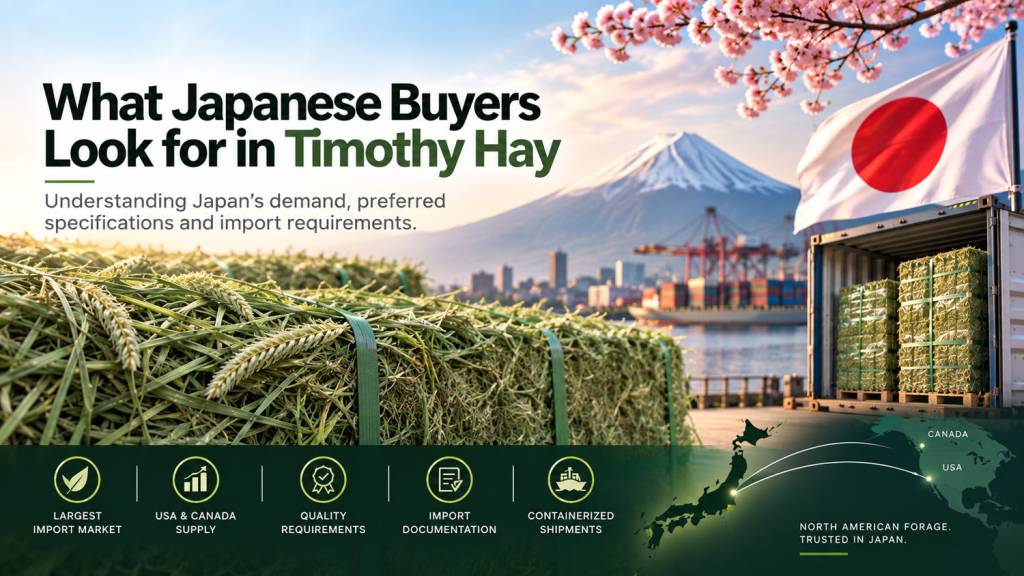
Japan imports more Timothy hay than any other country, and nearly all of it comes from the United States and Canada. For an exporter or a buyer sourcing on Japan’s behalf, that makes Japan less a question of “should we sell there” and more a question of how closely a supplier can match the documentation, format and supply consistency the market already runs on.
This guide works through why Japan’s demand is structurally different from other markets, how the US/Canada supply split actually breaks down, and what a shipment destined for Japan needs to clear customs.
Why Japan imports so much Timothy hay
Japan’s hay imports exist because domestic supply can’t meet domestic demand. According to USDA FAS’s Tokyo-based reporting, labor shortages limit how much forage Japanese producers can grow, and cattle farmers outside Hokkaido — where suitable agricultural land is more constrained — rely more heavily on purchased, largely imported forage than farmers in Hokkaido do.
That demand isn’t static. A more recent USDA FAS forage market update shows Japan’s total forage imports falling from 2.4 million metric tons in MY2022/23 to 2.2 million metric tons in MY2023/24 — a 9% decline — as declining cattle inventories and high import prices pushed some buyers toward price-competitive domestic alternatives. Even so, the same report notes that imported forage’s baled form and flexible purchase options continue to hold appeal, even as the price advantage narrows. For a market built around containerized, double-compressed bales, that’s a meaningful signal: format and purchasing flexibility matter to Japanese buyers independently of price.
Of that 2.2 million metric tons, hay specifically accounts for roughly 1.7 million metric tons, with the rest split across cereal straw, hay cubes, and alfalfa meal and pellets.
USA vs. Canadian Timothy hay in the Japanese market
Within that total, Timothy hay imports ran approximately 340,000 metric tons in MY2023/24 — and the US/Canada split is stark. Per the same USDA FAS report, the United States supplied roughly 245,000 MT and Canada roughly 94,000 MT, meaning North America supplied essentially all of Japan’s Timothy hay that year. Across Japan’s forage imports as a whole, the US held a 52% share (down from 60% in MY2020/21), Australia 26%, China 9% and Canada 8% — but Australia’s share is concentrated in oat hay, not Timothy, where North America remains dominant.
That has a direct implication for how a buyer should evaluate an exporter: in the Japanese Timothy market specifically, “US or Canadian” isn’t a question of which country is more established — both are. It’s a question of which specification, cutting and documentation package a given shipment needs, which is exactly the comparison this site’s companion article works through. Timothy Hay Exporter: USA vs. Canadian Timothy Hay →
What Japanese buyers evaluate in a Timothy hay shipment
USDA’s market reporting focuses on trade volumes and pricing rather than buyer-level quality preferences, so general statements about Japanese specification preferences beyond what’s documented above would be guessing. What we can say with confidence, because it holds for any commercial Timothy buyer regardless of destination, is which questions a Japan-bound shipment needs answered before it ships:
- Grade and visual presentation — what grade names actually describe →
- Physical condition on inspection — how to inspect Timothy hay before you buy →
- Fibre and digestibility figures on the certificate of analysis — ADF vs. NDF explained →
- Moisture at baling, which matters more than usual on the longer trans-Pacific transit — why moisture matters for export →
- Cutting — first cut vs. second cut Timothy →
Buyers sourcing for the Japanese market should request the certificate of analysis for the specific lot, the same way a buyer anywhere else would — Japan’s scale as a destination doesn’t change what determines whether a given lot is suitable, only how much documentation needs to travel with it.
Documentation and phytosanitary requirements for Japan
Japan’s import documentation requirements changed materially in 2023. According to USDA FAS’s guide to Japan’s updated phytosanitary certificate requirements, Japan began strictly requiring phytosanitary certificates from August 5, 2023 for a broad range of agricultural imports that were previously exempt. Whether a specific hay shipment needs one depends on its form and intended use — the same guide notes that products which are dried and also compressed, chopped or crushed may fall under a narrower exemption, which is relevant given that double-compressed baling is the standard export format for this trade. How double-compressed export hay is prepared →
This is exactly the kind of requirement the source itself says not to assume: USDA’s own guidance recommends that exporters confirm current requirements directly with Japanese quarantine authorities through their contracted importer, because the determination depends on the specific product form. Treat that as the standing instruction for every shipment, not a one-time check — Japan’s own documentation shows these rules can and do change. Full export documentation guide →
Choosing a Timothy hay exporter for the Japanese market
Given that US and Canadian supply both run deep into this market, the practical advantage goes to an exporter that can do three things: source and document Timothy from both countries rather than one, confirm current Japanese phytosanitary requirements for the specific bale format being shipped, and supply consistently across repeat orders rather than one container at a time. Request current Timothy hay availability for Japan →
Frequently asked
Why does Japan import so much Timothy hay?
Domestic labor shortages and limited agricultural land outside Hokkaido mean Japanese cattle farmers rely heavily on purchased, largely imported forage. Japan is the largest single destination for North American grass/Timothy hay as a result.
Does Japan prefer US or Canadian Timothy hay?
Both are major suppliers — USDA FAS data for MY2023/24 shows the US supplying roughly 245,000 MT and Canada roughly 94,000 MT of Japan’s Timothy hay imports, with North America supplying nearly all of it. The choice comes down to the specific lot and documentation, not a stated national preference.
What documentation does a Timothy hay shipment to Japan need?
At minimum, the standard export documentation set (commercial invoice, packing list, bill of lading, certificate of origin) plus, in most cases, a phytosanitary certificate under Japan’s requirements effective August 2023 — confirm the specific requirement for your bale format and intended use with your importer and Japanese quarantine authorities before shipping.
Is baled Timothy hay the standard format for the Japanese market?
Yes. USDA reporting specifically notes that imported forage’s baled form and flexible purchase terms remain a draw for Japanese buyers even as price competition from domestic alternatives increases.
Are Timothy hay prices to Japan rising or falling?
It varies by year and should never be assumed current — USDA reporting describes import forage prices rising sharply through MY2022/23 before softening in MY2024/25. Request a current quote rather than relying on a historical trade figure.
Request Timothy hay availability for the Japanese market
Tell us your target grade, cutting and volume, and whether you need US or Canadian origin — or both — and our export team will confirm current availability, documentation requirements and commercial terms.