A vague enquiry gets a vague quote. “Send me your best price on premium Timothy hay” tells an exporter almost nothing about what you actually need, and the quote that comes back will reflect the exporter’s assumptions, not yours. This guide works through the specifications worth including in a Timothy hay enquiry — what each one means, why it matters, and how to phrase it — so the quote you get back is one you can actually evaluate.
If you want the full step-by-step process view of how an order moves from enquiry to shipment, see how Timothy hay is prepared for export →. This article focuses specifically on the specification side of that first step.
Why specification quality determines quote quality
Grade names like “Premium” aren’t standardized across the trade — they describe where a lot sits within one exporter’s own range, not a fixed international standard. Two exporters can both offer “Premium Timothy” and mean different things by it. The same is true, to varying degrees, of cutting, moisture and bale format: each is a real variable, and an enquiry that doesn’t specify a position on each one leaves the exporter guessing at what will actually suit your use.
The specifications below aren’t a bureaucratic formality — they’re what lets an exporter identify a genuinely suitable lot on the first pass, rather than a round of back-and-forth corrections after a quote misses what you needed.
Grade — ask what it means, not just for a name
Don’t request “premium” or “supreme” Timothy by name alone. Ask what the exporter’s grade naming actually describes — what distinguishes it from their other grades — and request the certificate of analysis for the specific lot being offered. A grade name is a starting point for a conversation, not a specification you can act on by itself. What grade names actually describe →
Cutting — state first or second, and why
First-cut and second-cut Timothy differ in stem coarseness, seed head and texture, and availability shifts by season. If your market or application has a preference — equine retail often leans toward second cut for texture, bulk livestock buyers often don’t have a strong preference either way — state it. If you don’t know which suits your use, say so and ask the exporter to recommend one, rather than defaulting to whichever is being offered. First cut vs. second cut Timothy compared →
Nutrient and analysis specifications — the numbers to actually request
This is the specification importers most often skip, and the one that matters most for matching product to a ration or formulation. Two approaches work:
- If you have a target range — for a specific ration, formulation, or an existing specification you buy against — state it explicitly (for example, a target NDF or RFV range, or a maximum moisture percentage).
- If you don’t have a fixed target, ask the exporter to provide the certificate of analysis for the lot being offered, so you can evaluate it against your own requirement rather than relying on a grade name.
Either way, ask for the actual document, not a general spec sheet — analysis figures vary by lot, cutting and crop year, so a spec sheet from a previous shipment doesn’t describe the one you’re being quoted now. What ADF, NDF and RFV actually measure →
Moisture — specify it for transit, not just feed quality
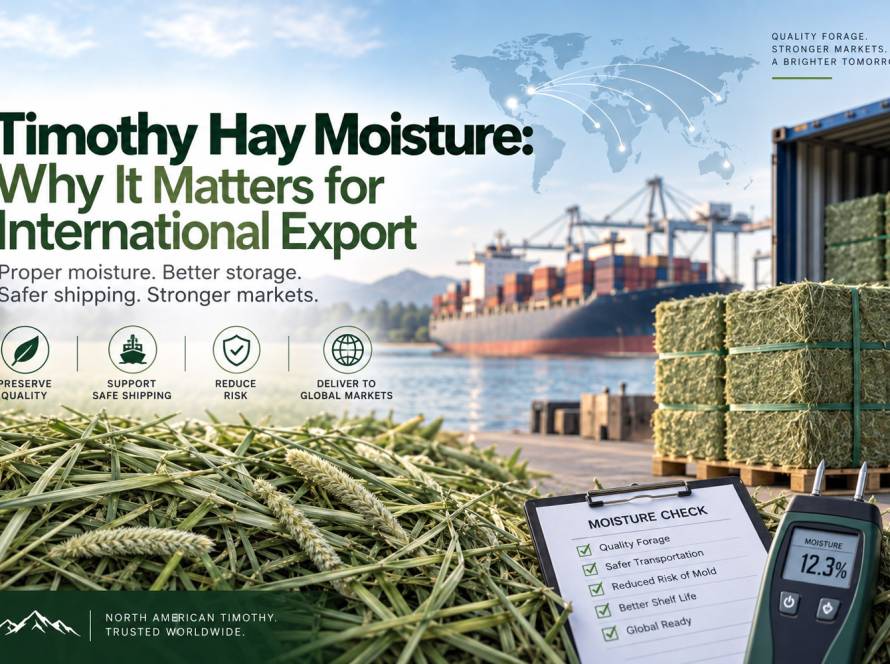
Moisture at baling affects two things: feed quality and transit risk. Hay baled too wet carries mould and heating risk over a multi-week ocean voyage, which matters even if the moisture level would be acceptable for a short domestic delivery. State a maximum acceptable moisture figure if you have one, or ask directly what moisture the lot was recorded at before loading. Why moisture matters for export →
Bale format and weight — specify for your handling, not theirs
State the bale format and weight that suits your own equipment, storage or repackaging process — don’t assume the exporter’s default export configuration will work on your end. A format optimized for container payload efficiency may be impractical for a buyer with limited mechanical handling, and a format built for bulk livestock feeding may not suit a distributor repackaging for retail. Double-compressed export formats explained → · Packaging and shipping options →
Quantity — state both the initial order and the ongoing volume
Specify your initial container quantity and, separately, your expected ongoing monthly or annual volume if this is meant to become a recurring programme. The two numbers serve different purposes for an exporter: the first sizes the immediate quote, the second indicates whether it’s worth planning supply consistency around your account. If you’re not ready to commit to a recurring volume, say this is a trial order — that’s a legitimate and common way to start a new supplier relationship.
Destination, Incoterm and documentation
State your destination country and port, and your preference for FOB, CFR or CIF pricing if you have one — otherwise ask the exporter to quote the options. Destination also determines which documents your shipment will need; requirements genuinely vary by country and change over time, so naming your destination clearly up front is what lets an exporter tell you accurately what documentation applies. Full documentation guide → · See how destination-specific requirements play out in practice →
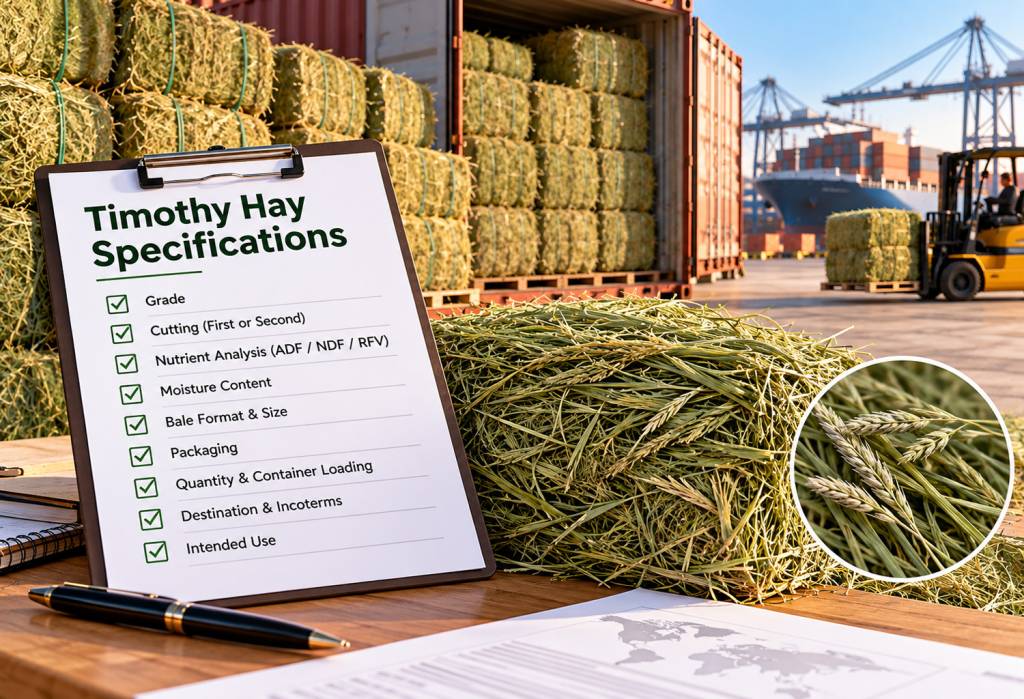
A specification checklist for your next enquiry
| Specification | What to state |
|---|---|
| Grade | Ask what the exporter’s grade name means, and request the certificate of analysis |
| Cutting | First or second cut — your preference, or ask for a recommendation |
| Nutrient/analysis target | A target range if you have one; otherwise request the lot’s certificate of analysis |
| Moisture | A maximum acceptable figure, or ask what the lot was recorded at |
| Bale format and weight | What suits your own handling, storage or repackaging — not the default export configuration |
| Quantity | Initial order size, and separately, your expected ongoing volume (or state it’s a trial) |
| Destination and Incoterm | Country, port, and FOB/CFR/CIF preference if you have one |
| Documentation needs | Let your destination drive this — ask what applies once destination is specified |
Send us a specification and request a quote →
Frequently asked
What’s the minimum information I need to give to get an accurate Timothy hay quote? At minimum: destination, approximate quantity, and intended use (equine, livestock, specialty feed, etc.). The more of the specifications above you can add, the more accurately a suitable lot can be identified on the first pass rather than after a round of corrections.
Do I need to specify an exact RFV or NDF number, or can I just ask for “premium” hay? You don’t need a fixed number if you don’t have one — but ask for the certificate of analysis for the actual lot being offered rather than relying on the grade name alone. “Premium” describes a position in one exporter’s range, not a standardized figure.
What if I don’t know which cutting or bale format I need? Say so, and ask the exporter to recommend one based on your market and intended use. This is a normal part of a first enquiry, not something you’re expected to already know.
Should I ask for a trial container before specifying a recurring volume? If this is a new supplier relationship, yes — state that it’s a trial, and discuss the recurring volume once you’ve evaluated the first shipment.
Can I change my specification after I’ve placed an order? Confirm this directly with your exporter before placing the order — agricultural product sourcing generally has less flexibility to change specifications mid-order than a manufactured good would, since a specific lot has already been selected against your original request.
Send us your specification
Use the checklist above as a starting point, or tell us what you’re not sure about and we’ll work through it with you.