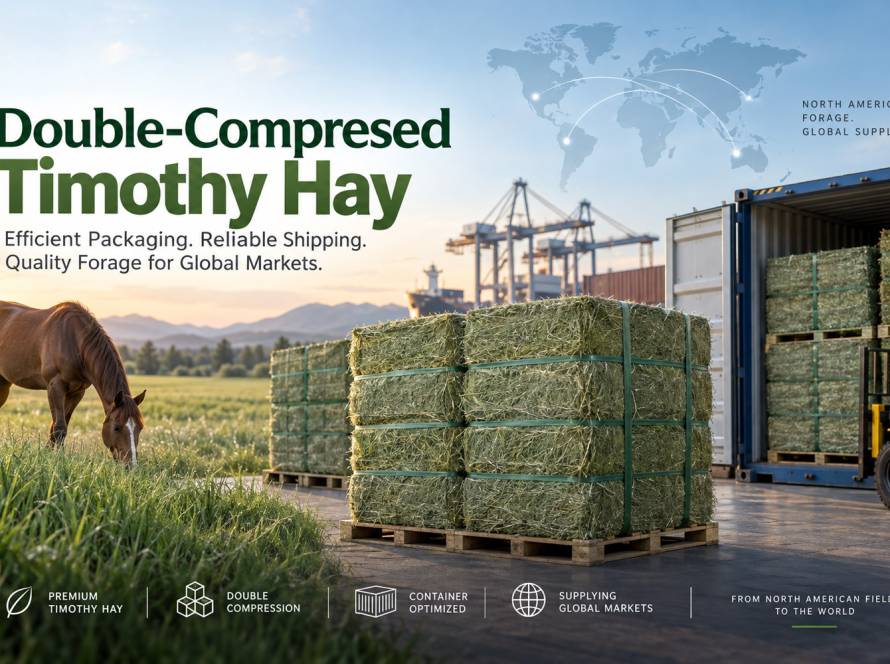
Timothy hay is a moderate-protein, fibre-rich grass hay used across dairy, beef and mixed livestock operations — usually as a fibre and roughage source within a ration rather than the primary protein driver the ration is built around. Whether it’s the right fit for your operation depends on the class of animal, the production stage, and what else is in the ration, not on Timothy being categorically better or worse than a legume hay like Alfalfa.
This guide is written for commercial buyers — dairy operations, beef and feedlot buyers, and distributors sourcing Timothy hay for livestock customers — evaluating what to specify before requesting a quote.
What Timothy hay brings to a livestock ration
Timothy is a cool-season grass hay, and its nutritional profile differs meaningfully from a legume hay like Alfalfa. According to Feedipedia, the feed composition database maintained by INRAE, CIRAD, AFZ and FAO, Timothy hay averages around 9.1% crude protein on a dry-matter basis — a figure that declines further as the plant matures — with neutral detergent fibre (NDF) around 65.4% and acid detergent fibre (ADF) around 37.8% of dry matter.
In practical terms: Timothy generally supplies less protein than Alfalfa and more structural fibre. That makes it a fibre and roughage contributor in most livestock rations rather than the sole source of protein — many operations feeding Timothy plan to supplement protein elsewhere in the ration rather than expecting the hay to carry it. These are general species figures, not a Western Forage lab result — actual protein and fibre content vary by cutting, maturity at harvest and crop year.
Timothy hay for dairy cattle
Grass hays like Timothy are sometimes used in controlled-energy strategies for dry and far-off dry cows, where the goal is diluting a ration’s energy density with bulk fibre. DAIReXNET, the dairy extension network run by land-grant universities, cautions that grass hays retain more energy than straw and are “not as effective in decreasing energy density” for this specific purpose — meaning Timothy can play a role in a controlled-energy dry cow diet, but it isn’t a direct substitute for the very-low-energy forages some programmes use, and may need to be processed or balanced carefully alongside other ingredients.
For lactating and production-stage dairy rations, Feedipedia notes that early-cut Timothy silage can approach Alfalfa silage in nutritive value when stored at similar fibre levels, though the lower protein content typically calls for supplementation elsewhere in the ration. This is general research, not a guarantee for any specific lot — the practical takeaway for a dairy buyer is to request the certificate of analysis for the hay being quoted and work out the ration implications with a nutritionist, rather than assuming a fixed nutritional value from “Timothy hay” as a category. Compare Timothy and Alfalfa hay in detail →
Timothy hay for beef cattle and feedlot operations
Roughage is a large share of most backgrounding and feedlot rations. Saskatchewan’s provincial agriculture guidance on backgrounding and feeder cattle nutrition notes that many backgrounding rations run 60–70% forage on a dry-matter basis, with good-quality long hay commonly fed during the first week of a weaning programme before grain is introduced — and specifically cautions against introducing Alfalfa too abruptly at that stage, which is where a grass hay like Timothy is often the more suitable early-stage forage.
In feedlot and finishing rations, hay and other roughage sources are typically coarsely processed and mixed with grain rather than fed free-choice, both to manage intake and to support normal rumen function. As with dairy, the right role for Timothy in a specific beef or feedlot ration depends on the production stage and the rest of the ration — a nutritionist or ration-balancing service is the right place to confirm inclusion rates, not a general guide like this one.
Blending Timothy with Alfalfa for livestock rations
Many livestock buyers don’t choose one hay type exclusively — blending Timothy with Alfalfa (or another legume) is a common way to balance protein against fibre and manage cost across a ration. Timothy contributes bulk fibre and palatability; Alfalfa contributes protein and calcium. The right ratio depends on the class of animal, production stage and what the rest of the ration already supplies, and is a question for your nutritionist rather than a fixed rule this article can set. Timothy vs. Alfalfa: how to decide → · Alfalfa hay for dairy & livestock →
Timothy hay bales for bulk livestock operations
Livestock buyers generally purchase in larger, more uniform volumes than equine retail or boarding customers, which changes which bale formats make sense:
| Format | Suits |
|---|---|
| Double-compressed large bales | High-volume dairy, beef and feedlot operations moving product by the container or truckload |
| Double-compressed small bales | Mixed operations wanting easier manual handling at the point of feeding |
| Full-cut bales | Buyers with mechanical handling suited to full-length bales |
| Half-cut bales | Smaller operations, manual feeding, or where storage space is limited |
Bale weight and how much lands per container depend on compression, moisture and the route your shipment takes — confirmed against your destination and equipment before the order is placed, not published as a fixed figure. See the bale formats and packaging options we supply →
What livestock buyers should specify in an enquiry
| Consideration | Why it matters for livestock buyers |
|---|---|
| Certificate of analysis (CP, NDF, ADF) | The figures that determine how Timothy fits into your ration formulation — request them for the specific lot, not a general spec sheet |
| Cutting and maturity | Protein and fibre shift substantially with maturity at harvest; state what your ration needs |
| Bale format and weight | Sets handling method and how much lands per container — see the table above |
| Consistency across loads | A recurring dairy or feedlot programme needs a predictable product; ask how a supplier assembles volume across fields and cuttings |
| Recurring supply volume | Monthly or annual tonnage, so a supplier can plan against your programme rather than quoting a one-off lot |
| Moisture | Affects both storage stability and, over a long voyage, mould and heating risk |
Request a Timothy hay quote for your operation →
Sourcing Timothy hay for livestock from North America
Timothy for livestock use is grown across established regions of the United States and Canada, and an exporter working across both origins can generally offer more flexibility on cutting, grade and volume than one limited to a single country’s current crop. Compare USA and Canadian Timothy hay as an exporter buyer →
Frequently asked
Is Timothy hay good for dairy cows? It can be, depending on the production stage. Timothy is lower in protein than Alfalfa and is more commonly used for dry or far-off dry rations, or blended with a legume hay for lactating cows, than as a stand-alone protein source. Confirm the role against your ration with a nutritionist and the certificate of analysis for the lot.
Can Timothy hay be fed to beef cattle in a feedlot? Yes — grass hays like Timothy are commonly used as roughage in backgrounding and feedlot rations, particularly early in a weaning programme before grain is introduced. Inclusion rates depend on the production stage and the rest of the ration.
Should I blend Timothy with Alfalfa for livestock rations? Many operations do, to balance fibre against protein and manage cost. The right ratio depends on the class of animal and production stage — a question for your nutritionist rather than a fixed rule.
What bale format is best for bulk livestock feeding? Double-compressed large bales generally suit high-volume operations with mechanical handling; smaller or half-cut formats suit operations with manual feeding or limited storage. See the packaging table above.
Does Timothy hay cost less than Alfalfa hay for livestock use? It varies by market, season and crop year, and we don’t publish prices here — protein-dense legume hay and fibre-focused grass hay are priced on different markets, so a direct per-tonne comparison isn’t meaningful without current quotes for both. Request current pricing for the specification you need.
Request Timothy hay for your livestock operation
Tell us your operation type, target specification and recurring volume, and our export team will come back with current availability, certificate of analysis, packaging options and commercial terms.