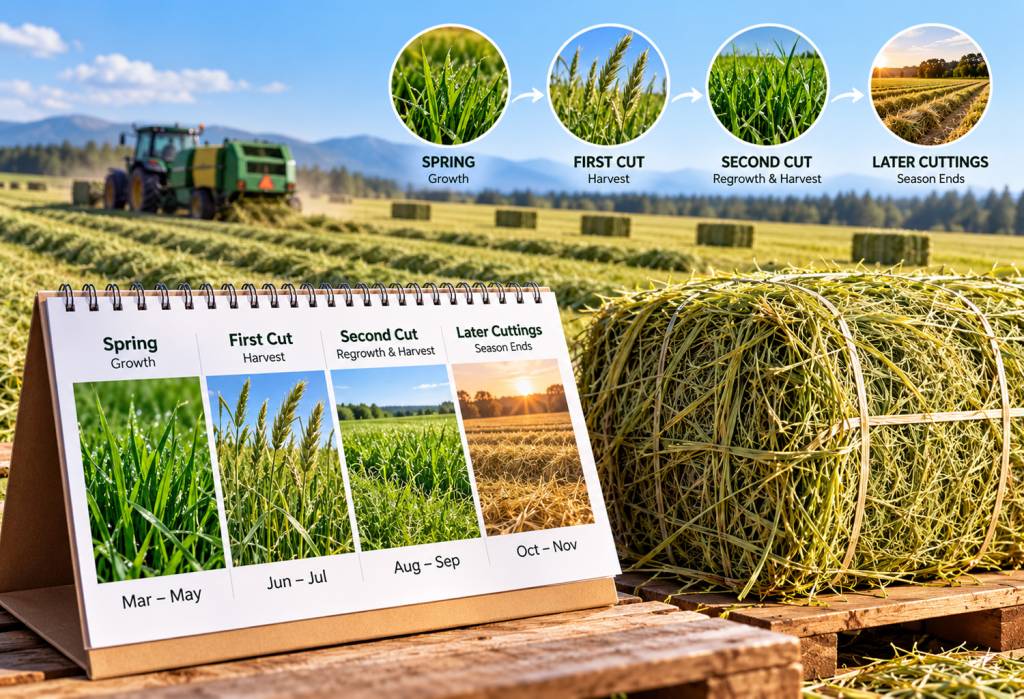
Timothy hay does not follow one fixed date on a calendar. First cut generally becomes available once the crop reaches the right growth stage in early to mid summer, and later cuttings follow as the field regrows through the rest of the season. The right time to place an order depends on which cutting you want and how far into the season you are buying, not a single date that applies every year or every region.
Why Timothy hay does not follow a fixed calendar
Timothy is cut based on how mature the plant is, not a date on the calendar. According to the USDA NRCS plant fact sheet for Timothy (Phleum pratense), the crop should be cut for hay or silage from early to full head, meaning the decision is tied to the seed head’s growth stage. Later cuttings are timed by watching for basal sprouts, new growth that appears at the soil surface once the field has recovered from the previous cut, rather than by counting a fixed number of weeks. Timothy is also described as a cool, humid climate crop that does poorly in drought or prolonged high heat, so a hot, dry stretch in a given year can slow regrowth in a way a mild season would not. See our full comparison of USA and Canadian Timothy hay for how growing region affects supply more broadly.
First cut timing
First cut is generally taken in early to mid summer, once the crop reaches the early to full head stage the USDA fact sheet describes. Exactly when that happens in a given year depends on when the crop came out of winter dormancy and how the spring weather played out. A late, cold spring pushes the whole season back; an early, mild one can bring first cut forward. This is one reason a supplier will often talk about “the current crop” rather than naming a fixed month: the stage that triggers cutting is the same every year, but the calendar date it falls on is not.
Second cut and later cuttings
Penn State Extension’s guidance on timing cuttings of cool season perennial grasses describes a typical interval of about five to six weeks between cuttings under good conditions, with some growers working anywhere from four to nine weeks depending on the quality and tonnage they are targeting. The same guidance notes that grass left uncut much past about forty days becomes more prone to leaf disease, while pushing a cutting too late in the season runs into harder drying conditions as autumn approaches. Timothy follows the same general pattern described by USDA: once basal sprouts appear after first cut, the field is approaching readiness for the next cutting. None of this is a fixed Timothy specific schedule; it describes how cool season grasses behave generally, and actual timing still depends on the specific field, region, and year.
How crop year and weather affect what is available when
A cold or wet spring that delays first cut tends to delay everything that follows it, since each later cutting depends on the field recovering from the one before. A dry or compressed season can bring cuttings closer together than usual, or in a severe drought year, prevent a later cutting from happening at all. This is the same variability this site’s other content refers to when it talks about requesting current crop photographs and lab analysis rather than relying on a fixed specification sheet. A grade or cutting that was widely available last season may be tight this one, for reasons tied to weather rather than anything an exporter controls.
When to order for each cutting
If you specifically want first cut, place your enquiry early in the season and expect lots to become available once the crop is cut, cured, and processed. See how Timothy hay is prepared for export for the steps that follow harvest before a lot is ready to ship.
If you want second cut for its finer texture, expect it later in the season, generally several weeks after first cut finishes. Supply can be tighter in a dry year, since second cut depends on enough regrowth happening after the first harvest.
If timing flexibility matters more to you than a specific cutting, ask your exporter what is currently available rather than requesting a cutting that has not been harvested yet. Asking for a cutting before it exists simply adds a wait that a flexible enquiry would not need.
Planning a recurring order around the season
Buyers with an ongoing monthly or annual requirement often blend across cuttings and crop lots through the year rather than locking into a single cutting for every shipment. See our guide to Timothy hay for livestock operations and our Timothy hay specifications guide for how to describe an ongoing volume requirement clearly. Placing a recurring order early in the season, even before you need the first shipment, gives your exporter more room to plan supply around your account rather than filling it from whatever happens to be on hand when you ask.
What to ask before ordering against the calendar
| Ask this | Because |
|---|---|
| Which cutting is currently available | Before specifying one you assume should be ready |
| How the current season’s weather has affected timing | A late spring or a dry summer changes the picture from a typical year |
| The moisture figure recorded at the time of this specific cutting | Not a general figure from a past season |
| Whether a trial container makes sense | Before committing to a recurring schedule built around a particular cutting |
Request a Timothy hay export quote →
Frequently asked
When is Timothy hay first cut in North America? Generally in early to mid summer, once the crop reaches the growth stage described by USDA as early to full head. The exact timing shifts year to year with weather and varies by growing region.
Is second cut Timothy hay always available later in the year? Generally yes, since it depends on the field regrowing after first cut, but how much later and how much volume is available depends on the season’s weather and moisture.
Does a bad growing season delay when hay becomes available to order? Yes. A cold spring, a dry summer, or any weather that slows the crop’s growth stage or its regrowth after a cutting will shift when that cutting becomes available, sometimes by several weeks.
Should I place my order before or after harvest? Both are common. Ordering before harvest, with a stated cutting preference, works well for planning a recurring programme. Ordering after a specific cutting is available suits a buyer who wants to see the current crop’s analysis before committing.
Can I lock in a cutting preference for a recurring order? Tell your exporter your preference and they can plan around it, but availability still depends on the season, so build in some flexibility rather than assuming the same cutting will always be ready on the same date every year.
Request a Timothy hay export quote
Tell us your target cutting, your timing, and whether this is a single order or a recurring programme, and our export team will tell you what the current season actually supports.