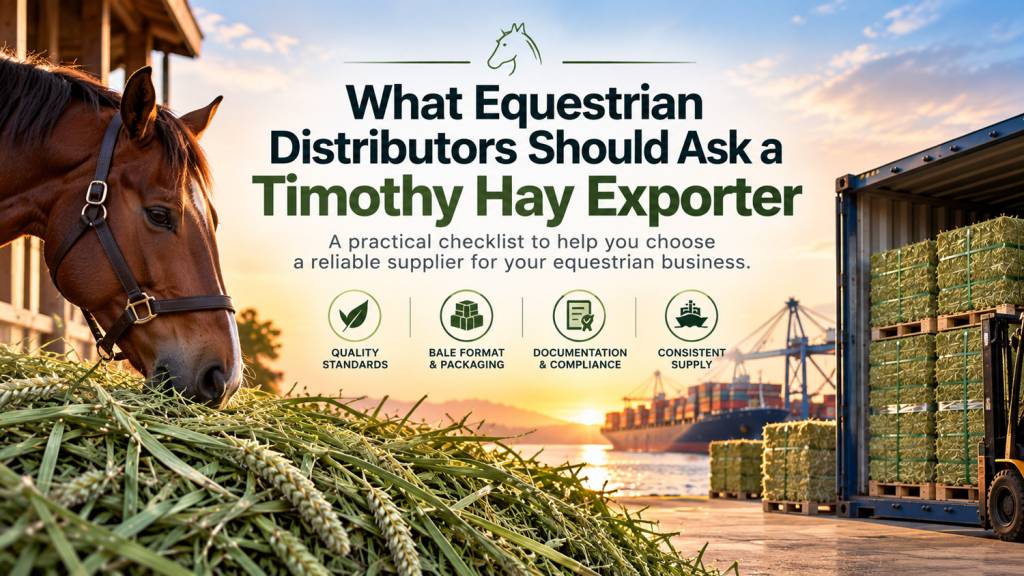
Choosing a Timothy hay exporter for an equestrian distribution business is a different exercise than choosing one for bulk livestock feed. Volume discounts and delivered cost per tonne still matter, but an equestrian distributor is also buying presentation, consistency across repeat orders, and a product their own customers — stables, tack shops, individual horse owners — will judge by appearance as much as analysis. The questions below are built around that difference.
Why equestrian buyers need a different exporter checklist
Hay & Forage Magazine’s guidance on buying horse hay — written for individual horse owners sourcing locally — makes a point that holds just as well at container scale: experienced, specialized suppliers understand horse-specific risks that a general livestock-hay seller may not prioritize the same way, from zero tolerance for poisonous weeds to how maturity affects suitability for idle versus working horses. An international distributor is asking the same underlying question — can this supplier be trusted with something my customers will inspect closely — just at a different scale, with added questions around documentation, consistency across shipments, and international logistics that a local hay buyer never has to think about.
Questions about grade, cutting and quality
- What does your grade naming actually describe? Grade names like “Premium” aren’t standardized across the trade — ask what the term means for this specific exporter’s range, not just the label. What grade names actually mean →
- Can I see the certificate of analysis for this lot? Not a general spec sheet — the actual document for the hay being quoted. What ADF and NDF measure, and how to read an analysis →
- Is this first cut or second cut, and why does it suit my market? Neither is universally better for equine use — the right answer depends on your customer base. First cut vs. second cut compared →
- What’s the moisture figure for this lot, and how was it confirmed? Moisture affects mould risk over a long ocean transit, which matters more on a multi-week voyage than it does for a local delivery. Why moisture matters for export →
- Can I see current crop photographs, or arrange a sample before committing to a full container? A distributor reselling on appearance needs to see the actual lot, not a stock photo. How to physically inspect Timothy hay before you buy →
Questions about bale format and packaging
- What bale formats do you offer, and which suits equine retail specifically? Smaller, more manageable formats often suit individual stables and retail resale better than the large compressed formats bulk livestock buyers prefer.
- Is this hay double-compressed, and what does that mean for bale condition on arrival? Compression affects freight economics, but dry or brittle hay can lose leaf and suffer damage under pressure — worth asking how the exporter balances the two. How double-compressed export hay is prepared →
- What’s the bale weight, and does it suit my customers’ handling capability? A format optimized purely for container payload may be impractical for a small stable to handle manually.
Questions about supply consistency
- How do you assemble volume for a single order — one field and cutting, or several blended together? A lot sourced from a consistent cutting is a more predictable basis for repeat retail supply than hay blended from multiple partial lots.
- Can you supply the same specification on my next order, or does availability shift season to season? Equine retail customers notice inconsistency between deliveries in a way a feedlot operation often doesn’t.
- What happens if the grade or cutting I usually order isn’t available? A good exporter tells you honestly rather than substituting silently.
Questions about documentation and import requirements
- What documentation comes with every shipment as standard? At minimum: commercial invoice, packing list, bill of lading, certificate of origin, and a phytosanitary certificate where your destination requires one. Requirements genuinely differ by country and change over time — the UK, UAE, Japan and other destinations don’t share one rulebook, so ask the exporter how they confirm current requirements rather than assuming a standard package covers every market. Full export documentation guide →
- Who is responsible for confirming import requirements — you or me? Get this answered before the order is placed, not after a shipment is held at customs.
Questions about logistics and commercial terms
- What Incoterm are you quoting — FOB, CFR or CIF — and what does it actually include? The same three letters can mean different things depending on the exporter; ask them to walk through what’s covered.
- What’s the delivered cost per tonne, not just the unit price? A lower price on lightly compressed or inconsistent hay can produce a higher landed cost once freight and handling are factored in.
- Can I start with a trial container before committing to a recurring programme? A reasonable exporter should be comfortable with this for a new relationship.
- What are your typical lead times, and do they change seasonally? Equine demand often has its own seasonal rhythm — ask whether supply timing matches it.
A checklist for your next exporter conversation
| Category | Key question |
|---|---|
| Grade & quality | What does your grade name mean, and can I see the certificate of analysis? |
| Cutting | First or second cut — and why does it suit my market? |
| Moisture | What’s the figure for this lot, and how was it confirmed? |
| Inspection | Can I see current crop photos or get a sample before a full order? |
| Bale format | Which format suits equine retail handling specifically? |
| Consistency | How is volume assembled, and will my next order match this one? |
| Documentation | What’s included as standard, and who confirms destination requirements? |
| Commercial terms | What Incoterm, and what’s the landed cost per tonne — not just unit price? |
| Trial order | Can I start with a trial container? |
Request current Timothy hay availability for your equestrian market →
Frequently asked
How is vetting a Timothy hay exporter different for equine markets versus livestock markets? Equine distributors generally weight presentation, consistency and bale handling more heavily, because their own customers judge hay partly on appearance. Livestock and dairy buyers typically weight certificate-of-analysis figures and delivered cost per tonne more heavily. The underlying documentation and logistics questions are the same either way.
Can I request a sample before placing a full container order? Ask directly — a supplier confident in their product should be comfortable with a trial container or sample ahead of a recurring order, particularly for a new relationship.
How do I know if “premium” Timothy hay is actually premium? Ask what the term means for that specific exporter’s range and request the certificate of analysis for the actual lot — “premium” isn’t a standardized grade across the industry. Full explanation of what grade names mean →
Should I work with one Timothy hay exporter or source from several? There’s no universal answer — a single reliable exporter simplifies documentation and consistency; multiple suppliers can hedge against seasonal or crop-year shortfalls. Either way, the vetting questions above apply to each relationship individually.
What documentation should every Timothy hay shipment include? At minimum a commercial invoice, packing list, bill of lading and certificate of origin, plus a phytosanitary certificate where your destination requires one. Confirm current requirements for your specific country before the order ships, since they do change. Full documentation guide →
Request Timothy hay for your equestrian distribution business
Tell us your market, preferred cutting and grade, and target volume, and our export team will come back with current availability, crop photographs, and documentation details for your destination.