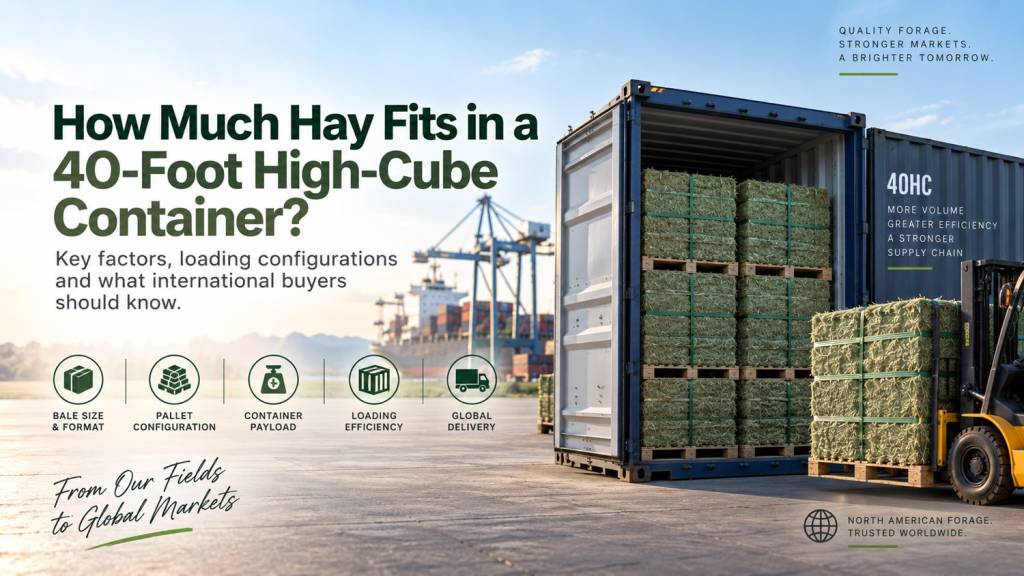
“How much hay can you load in one 40-foot container?”
It is one of the first questions international forage buyers ask.
The answer is important because container utilization directly affects landed cost per metric ton.
However, there is no universal number that applies to every hay shipment.
The quantity of Timothy or Alfalfa Hay that can be loaded into a 40-foot high-cube container depends on the crop, compression, bale format, pallet configuration and transportation limitations.
Why 40-Foot High-Cube Containers Are Used for Hay
Hay is a relatively bulky agricultural commodity.
For international shipments, a 40-foot high-cube container provides additional internal volume compared with smaller container formats and is therefore commonly used for compressed forage.
Combining a high-cube container with double-compressed hay can significantly improve transportation efficiency.
What Determines the Total Hay Weight?
Several variables affect the final loading quantity.
- Hay Type
Timothy and Alfalfa do not necessarily compress or load identically.
Crop characteristics and density can vary.
- Bale Format
Full-cut, half-cut and other bale configurations have different dimensions and handling characteristics.
- Compression
The effectiveness and consistency of compression affect how efficiently the available container volume is used.
- Pallets
Pallets consume physical space and add weight.
However, many commercial customers prefer palletized configurations because they simplify unloading and distribution.
- Crop Density
Not every Timothy crop has identical physical characteristics.
Stem structure, leaf content and moisture can influence bale density.
- Container Payload
A container has weight limitations in addition to physical volume.
- Inland Transportation
The container must also comply with applicable road, rail, terminal and transportation requirements before reaching the vessel.
This can sometimes become the limiting factor before every cubic foot of container volume is filled.
Typical Western Forage Loading
For many Western Forage compressed-hay programs, a 40HC shipment can be in the general range of approximately 25–26 metric tons.
This should be treated as an indicative commercial range—not a guaranteed quantity for every container.
The final weight depends on the actual crop, bale configuration, pallets and transportation requirements.
Western Forage confirms expected shipment specifications when quoting the selected product.
How Many Pallets Fit?
A typical Western Forage export configuration may use approximately 18 pallets, depending on bale type and loading plan.
However, pallet size and configuration can change according to the shipment.
Our objective is to create a configuration that balances:
- Efficient use of container space
- Bale protection
- Weight distribution
- Customer unloading requirements
- Transportation limits
How Many Bales Fit?
Again, it depends on bale size.
A container of smaller double-compressed bales will naturally contain more individual bales than one using larger formats.
For example, full-cut double-compressed Timothy bales may be prepared in approximately 55–60 kg formats for certain programs, but the actual bale weight should be confirmed against the lot and shipment.
Importers should therefore calculate based on:
Total Net Hay Weight ÷ Approximate Bale Weight = Estimated Bale Count
The final packing list should reflect the actual shipment.
Why Maximum Weight Is Not Always the Best Objective
Trying to force the maximum possible amount of hay into every container can create operational problems.
Commercial loading should also consider:
- Container limits
- Inland transportation limits
- Weight distribution
- Bale integrity
- Pallet stability
- Door clearance
- Safe unloading
The objective is efficient and compliant loading, not simply the highest possible number.
Full-Cut vs. Half-Cut Loading
Full-cut and half-cut double-compressed hay can produce different bale dimensions and loading configurations.
Importers should choose the format according to their market requirements rather than container weight alone.
For equestrian markets, maintaining forage length may be commercially important.
Other distribution channels may prefer smaller or easier-to-handle formats.
Palletized vs. Floor-Loaded Hay
Both configurations can be considered depending on the program.
Palletized hay can simplify mechanical unloading and warehouse handling.
Floor loading may use container space differently but can require additional labor at destination.
The best option depends on:
- Importer warehouse setup
- Available forklifts
- Labor cost
- Bale size
- Distribution method
- Customer requirements
Calculate Landed Cost Per Metric Ton, Not Just Container Price
A lower container freight rate does not necessarily mean a lower landed forage cost.
Importers should calculate:
Product Cost + Inland Logistics + Ocean Freight + Destination Costs ÷ Net Metric Tons
This produces a much more meaningful comparison.
For example, if two suppliers quote similar container freight but one configuration carries materially less forage, the landed freight cost per metric ton will be higher.
Information Buyers Should Request
Before confirming an export hay shipment, request:
- Estimated net hay weight
- Bale type
- Approximate bale weight
- Estimated bale count
- Pallet count
- Product origin
- Grade
- Cutting
- Moisture
- Loading method
- Incoterm
- Destination port
This allows buyers to compare quotations on a more consistent basis.
Western Forage Container Loading
Western Forage supplies and prepares North American Timothy and Alfalfa Hay for international container shipment.
Through our in-house compression operation and export team, we can coordinate bale preparation, pallet configuration, container loading and applicable export documentation.
Current loading specifications are confirmed according to the selected crop and shipment rather than relying on one universal container figure.
Request a Containerized Hay Quote
When requesting a quotation, provide:
- Product
- Grade
- Cutting
- Bale format
- Destination port
- Number of containers
- Expected monthly requirement
- FOB, CFR or CIF preference
Our team can then provide an applicable product quotation and estimated loading configuration.
[View Packaging & Shipping]
[Explore Timothy Hay]
[Request Container Pricing]