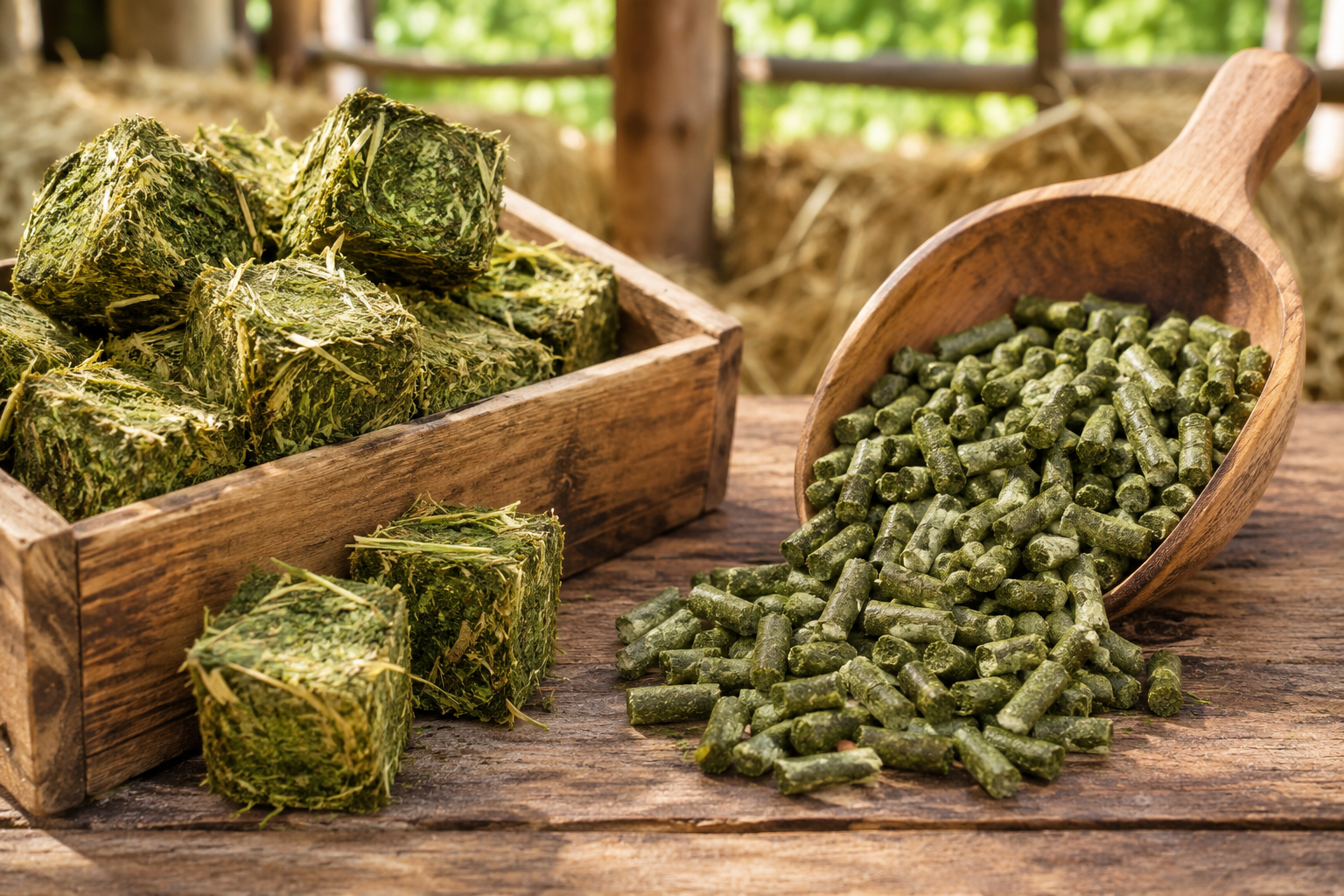
Alfalfa cubes and alfalfa pellets both start from the same crop, but they are not the same product once they reach a feed bin. One is a larger compressed piece that can replace loose hay. The other is a small, dense, uniform piece more often blended into a complete ration. Knowing which is which, and what each is actually suited for, matters before you place an order, not after the container arrives.
Why the difference matters when you are sourcing alfalfa
A buyer who asks for alfalfa cubes and receives alfalfa pellets, or the reverse, is not getting a slightly different size of the same thing. The two formats are processed differently, handle differently, and are fed differently. According to Western Forage’s own Timothy and Alfalfa Hay Pellets specification page, hay pellets are generally smaller, denser compressed forage products, while hay cubes are larger compressed pieces that may retain a different physical fiber structure. That single distinction, size and density rather than a difference in ingredients, is the starting point for everything else in this guide.
How alfalfa hay cubes are made
A University of Kentucky Cooperative Extension fact sheet on alfalfa cubes for horses describes two manufacturing routes. In the dehydrated method, alfalfa is cut early, partially dried in the field, then picked up and chopped with a forage harvester, transported to a processing plant, dehydrated to about 95 percent dry matter, and then cubed. In the sun cured method, alfalfa is dried in the field in the normal way, baled, transported to the plant, then chopped and cubed from the baled hay. Either way, the end result is a larger, denser piece than loose hay, built to be handled and fed as a near replacement for long stem forage.
How alfalfa hay pellets are made
Western Forage’s own pellets page describes alfalfa pellets as made from processed alfalfa forage, as part of a wider pellet range that also includes Timothy pellets, a Timothy and alfalfa blend, and sugar beet pellets. The page does not publish the specific grinding, steam conditioning or die pressing steps used, and notes that manufacturing detail may be available for selected products on request. What the page does make clear is the result: a pellet is a far smaller, more uniform piece than a cube, intended to mix consistently into a blended ration rather than to stand in for a flake of hay.
Size and density: the core physical difference
Beyond the two product descriptions above, this is the one place a buyer can rely on a direct, first party comparison rather than piecing one together from separate sources. Western Forage’s own specification FAQ states plainly that pellets are the smaller, denser option and cubes are the larger piece that keeps more of its original fiber structure. In practice, that single sentence answers most of the “which one do I need” question before any nutrition table does. A buyer blending a complete ration at a feed mill is usually thinking in pellet terms. A distributor supplying a format that can replace baled hay on a shelf is usually thinking in cube terms.
Nutrition: how cubes compare to long stem alfalfa hay
The Kentucky fact sheet includes a direct comparison table between alfalfa hay and alfalfa cubes, both expressed on a dry matter basis. Alfalfa hay is listed at 2.48 Mcal per kg digestible energy, 19.9 percent crude protein, and 1.28 percent calcium. Alfalfa cubes are listed at 2.45 Mcal per kg digestible energy, 19.0 percent crude protein, and 1.44 percent calcium. The fact sheet’s own conclusion is that alfalfa cubes are similar to long stem hay in digestible energy, crude protein and calcium content. Two caveats matter here. First, the cube figures in that table are described as industry values from cube manufacturers, not independently tested results, so treat them as a general guide rather than a certificate of analysis for any specific lot. Second, this table compares cubes to hay, not pellets to hay or cubes to pellets. No single source reviewed for this guide publishes an equivalent independent pellet versus hay nutrition table, so a buyer who needs that comparison for a pellet order should request a certificate of analysis for the specific lot rather than relying on a general figure.
Advantages of alfalfa cubes
The Kentucky Extension fact sheet lists several practical advantages cubes have over loose, long stem hay. Cubes are not wasted to the same extent as long stem hay, since horses tend to sort and discard leaves and fine material from loose hay in a way they cannot with a cube. Cubes are sold with a guaranteed minimum nutrient content, so intake is more predictable than with hay that varies cutting to cutting. Cubes have little dust, which the fact sheet suggests can make them a reasonable alternative for horses with certain respiratory sensitivities. Cubes are also more dense than hay, so they take less storage space and allow a truck to be loaded closer to its full legal capacity, which can reduce shipping cost over an equivalent hay shipment covering the same distance.
What to watch for when feeding cubes
The same fact sheet is equally direct about the risks of treating cubes like free choice hay. Horses fed cubes to appetite ate 17 to 25 percent more cubed alfalfa than they would have eaten as loose hay, and the fact sheet warns that cubes must be fed in a controlled, limit fed manner to avoid overweight horses and, more importantly, to avoid serious digestive upset such as colic. Cubes also need protection from weather to prevent spoilage from excess moisture, and processing adds to the cost of the feed compared with unprocessed hay. None of this is a reason to avoid cubes. It is a reason to feed them against a measured ration rather than leaving a full bin available around the clock.
Choke risk and soaking: what the research actually says
This is an area where precision matters more than a quick summary. An AAEP article on choke in horses, written by Lillian Haywood, VMD, states that some feeds such as hay cubes, hay stretcher, or beet pulp should be soaked before feeding to reduce the likelihood of choke. Hay pellets are not named in that specific preventive list. Separately, the same article notes that horses who choke on long stem hay may need to eat soaked hay cubes or soaked hay pellets instead, as part of managing a horse after a choke episode, not as a general feeding rule for every horse. Read together, the article supports soaking cubes as a sensible precaution for horses prone to eating quickly or with a history of choke, and it supports soaked pellets as one option for a horse recovering from a choke episode. It does not state that pellets are generally safer or riskier than cubes, and this guide does not make that claim either. Any horse with a history of choke, dental issues, or a tendency to bolt feed should be managed on a vet’s advice regardless of which format is being fed.
What to specify when you order either format
| Specify this | Why it matters |
|---|---|
| Format: cube or pellet | The two are not interchangeable in handling, storage or feeding rate |
| Moisture content | Affects spoilage risk and storage life for either format |
| Crude protein and crude fiber | Western Forage’s own spec page lists these as figures a buyer can request |
| ADF and NDF | Listed alongside protein and fiber as requestable specification figures |
| Pellet diameter or cube dimensions | Confirms the physical size matches your handling and feeding equipment |
| Product density and packaging | Determines how much usable product a given container or bag actually holds |
| Country of origin and documentation | Import requirements vary by destination and should be confirmed in advance |
Request an alfalfa cubes or pellets export quote →
Frequently asked
Are alfalfa cubes and alfalfa pellets made from the same alfalfa?
Generally yes, both come from processed alfalfa forage. The difference is in the size and density of the finished piece, not necessarily the underlying crop.
Which one is better for my operation, cubes or pellets?
It depends on the application. Cubes are a larger piece more suited to replacing baled or loose hay. Pellets are smaller and denser, more suited to blending into a complete feed ration. Neither is a universal upgrade over the other.
Do I need to soak alfalfa cubes before feeding them?
Soaking is recommended by AAEP as a precaution against choke for horses that eat quickly or have a history of choking, not as a universal requirement for every horse. Ask your vet if your specific animals are at elevated risk.
Is the nutrition content of cubes and pellets the same as loose hay?
University of Kentucky Extension data shows alfalfa cubes are similar to long stem alfalfa hay in digestible energy, protein and calcium, based on industry reported figures. A comparable independent figure for pellets was not found in the sources reviewed for this guide, so request a certificate of analysis for the specific lot you are ordering.
Can I request a specific format for a recurring order?
Yes. State whether you need cubes, pellets, or a blend product as part of your specification, alongside moisture, protein, fiber and packaging requirements. See our Timothy and Alfalfa Hay Pellets page for the current product range.
Request an alfalfa cubes or pellets export quote
Tell us the format, grade and volume you need, and our export team will confirm what is currently available.